Every export business talks about finding the right logistics partner, the right payment processor, the right sourcing agent. But almost nobody talks about the tool they use every single day to communicate with all of those partners: their cross-border chat tool.
And that's a mistake, because the wrong communication tool silently costs you deals. A delayed response because you didn't see a Telegram notification. A mistranslated price quote that made you look unprofessional. A WhatsApp ban that cut off 200 client contacts overnight.
Here's what export businesses actually need from a cross-border chat tool in 2026 — and how to pick one that won't let you down.
What features should a cross-border chat tool actually have?
Forget the marketing feature lists. Based on interviews with 30+ export business owners across Southeast Asia, China, and Europe, here are the features that actually matter in production:
1. Platform coverage that matches your market. If you sell to Brazil, you need WhatsApp. Japan? Line. Eastern Europe? Telegram. Middle East? WhatsApp + Telegram. A tool that doesn't cover your specific target markets is useless, no matter how good the translation is.
2. Translation that handles industry terminology. Generic translation engines choke on trade terms. "Bill of lading," "letter of credit," "incoterms" — these have precise legal meanings that a generic "the bill of loading" translation completely misses. Your tool needs to support custom terminology glossaries.
3. Message delivery reliability. When a client sends you a purchase order on WhatsApp at 11 PM their time, you need to see it at 11:01 PM your time. Not the next morning when you manually open WhatsApp and find "connecting..." spinning. Message sync delays are the silent deal-killer.
4. Data sovereignty. This is the feature nobody talks about until it's too late. Cross-border communications contain commercially sensitive information — pricing, supplier details, customer lists, payment terms. If your chat tool stores this data on cloud servers in a jurisdiction you don't control, you have a legal exposure you might not know about. According to a Gartner compliance advisory, over 60% of international trade disputes involving digital communications in 2024 cited data jurisdiction as a contested issue.
Free vs paid cross-border chat tools: which is right for your business?
There's a natural instinct to use free tools — WhatsApp Web is free, Google Translate is free, so why pay? But the "free" approach has hidden costs that compound as your business grows:
| Factor | Free Tools (WhatsApp Web + Google Translate) | Paid Unified Platform (OneChat) |
|---|---|---|
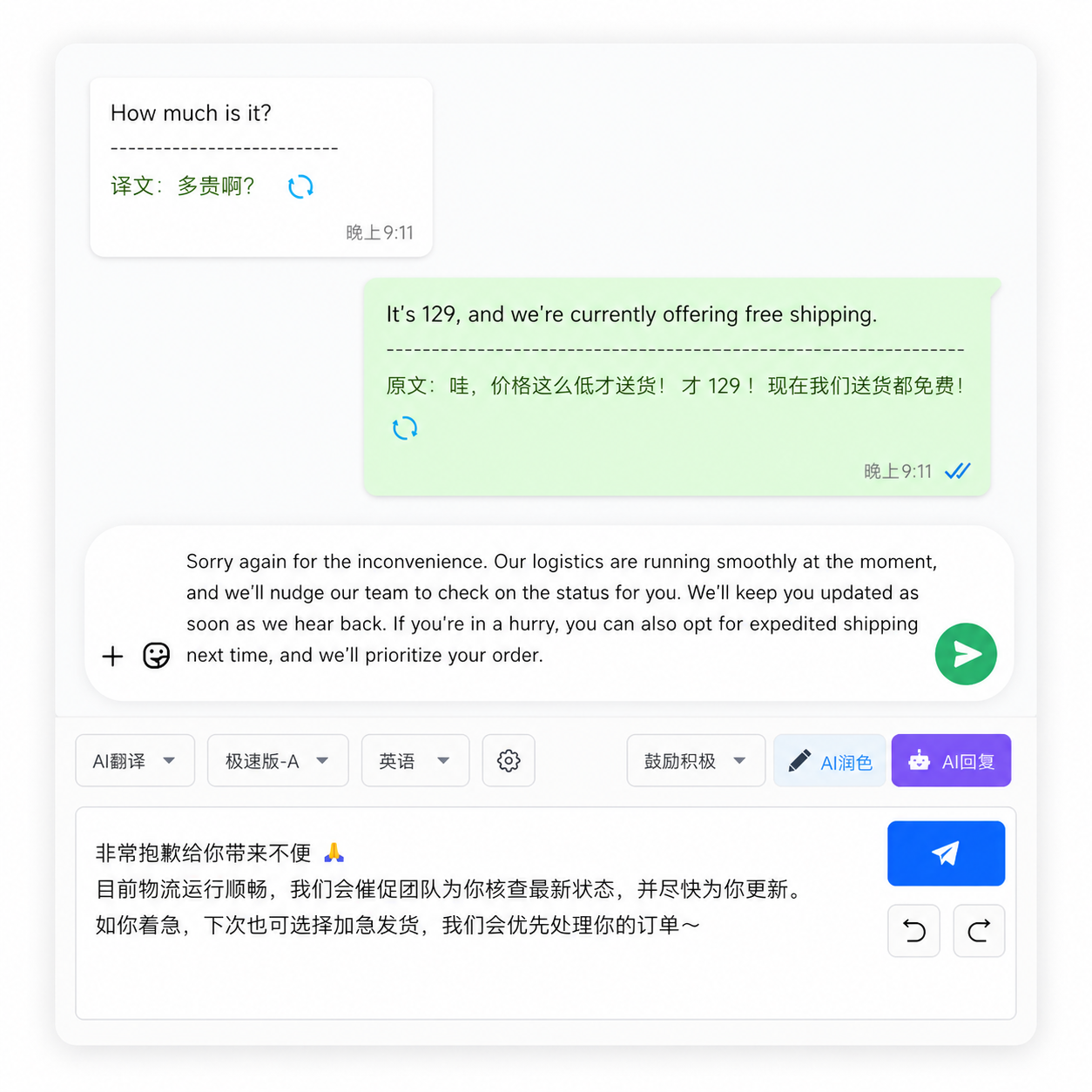
| Platform coverage | WhatsApp only (via Web) | 36+ platforms in one window |
| Translation workflow | Copy → paste → translate → copy → paste (5 steps) | Inline, automatic (0 steps) |
| Multi-language management | Manual language switching per conversation | Automatic detection + per-contact language preference |
| Team access | One device, one user | Multi-seat with role-based permissions |
| Ban risk | Single point of failure — ban = lose all contacts | Multi-account management reduces single-point risk |
| Data storage | On device only — lost if phone breaks | Local encrypted storage + optional backup |
| Compliance | No audit trail, no data control | Full message history, exportable records |
| Real cost | ~45 min/day in manual translation + switching | $15-30/month |
The math is simple: if your time is worth more than $20/hour, the 45 minutes you save daily with a unified platform pays for the subscription in less than 2 days. And that's before accounting for the deals you win because you respond faster.
Why WhatsApp-only is a risky strategy for export businesses
Many small exporters run their entire international communication through WhatsApp. It works — until it doesn't. WhatsApp's terms of service prohibit commercial use through unofficial clients, and account bans can happen without warning. When you've built 500 client relationships on a single WhatsApp number that gets banned overnight, the business impact is catastrophic.
A cross-border chat tool that supports multiple platforms gives you platform diversification. If WhatsApp goes down or your number gets flagged, you still have Telegram, Line, and Messenger channels open with your clients. This isn't just convenience — it's business continuity planning.
According to Statista, no single messaging platform captures more than 45% of the global market. WhatsApp dominates in Latin America and parts of Europe, WeChat in China, Line in Japan and Thailand, Telegram in Eastern Europe and the Middle East. If your export business spans multiple regions, a single-platform strategy is leaving money on the table.
FAQ Schema
Your clients are on many platforms — you should be too. OneChat brings WhatsApp, Telegram, Line, and 36+ platforms into one unified window. Built-in AI translation covers 100+ languages. Voice messages auto-transcribed and translated. And everything stays on your device with 100% local storage — your business data never touches a cloud server you don't control.
Try OneChat Free →